Rules

Concepts and Keywords

A

Active Effects

p. 17

Active effects begin with a bold keyword (“Next Turn:”, “This Round:”, etc.), followed by the card text. This keyword indicates when the card text takes effect and how long it remains in effect.

If your Active effect has a Radius, it is always calculated from your current space (it “moves” with you).

After you are done performing the action, if it has an active effect, turn the card on its side to signal this to other players (See page 7). Once the effect no longer applies, flip the card vertically again.

An Active effect on your card is cancelled:

  • When it no longer applies
  • If you are defeated
  • When the card changes state (See page 10), including at the end of the round

In cases when multiple Active effects come into effect at the same time, and the order in which they are applied matters, use the same method as when resolving tied initiative (See page 7), but do not flip the Tie Breaker coin.
Adjacent

p. 17

Adjacent spaces are any two spaces that share a border. Two units are adjacent if they occupy adjacent spaces. Two Zones are adjacent if they have at least two non-terrain spaces that are adjacent to each other.

After the Attack

p. 17

Apply this text after the target of your attack defends or is removed. See “Attack/Defense Detailed Order” on page 14.

B

Battle Zone

p. 17

The Battle Zone is a Zone where the minions are currently located. There is only one Battle Zone per lane.

Before the Attack

p. 17

Apply this text before the target of your attack defends or is removed. This effect happens even if the attack itself fails to connect due to range or other restrictions. See “Attack/Defense Detailed Order” on page 14.

Block

p. 17

Prevent the attack completely if the condition is met. See “Block” on page 14.

C

Choose (One / Twice / Up to / etc.)

p. 17

Choose a bullet point (or bullet points) and apply that text, ignoring the rest. See “Modal Actions” on page 10.

Closer (Space)

p. 17

A space is closer to you than another space if there are fewer spaces on the shortest path of spaces connecting you and that space (including spaces with obstacles).

Counts as

p. 17

If an object counts as an object of a different type, all rules and qualities of that object are replaced by the rules and qualities of the object type(s) it now counts as.

D

Defeat

p. 17

Remove the defeated enemy unit and collect the corresponding amount of coins. You can never defeat a friendly unit. No exceptions. (See page 13).

Direction

p. 17

There are six directions on a hexagonal board. Moving in the same direction means moving in a straight line in one of those six directions. See “Straight Line”.

Discard

p. 17

See “Changing Card States” on page 10.

E

Empty (Space / Spawn Point)

p. 17

An empty space is a space with no obstacles. An empty space can have a Spawn point. An empty Spawn point is a Spawn point in an empty space.

End of Turn (Active Effect)

p. 17

The text after a bold “End of turn” keyword is applied once, at the end of the current turn (after all players have had their chance to act). See “Active Effects”.

End of Round (Active Effect)

p. 17

The text after “End of Round” keyword is applied once, at the end of this round. See “Active Effects”.

F

Farther / Farthest

p. 17

Whenever you need to figure out the distance between two spaces or objects, count the spaces between them (including spaces with obstacles).

Friendly

p. 17

“A friendly unit” means another unit on your team. It never includes you. If a card affects your hero, it will explicitly say so (“You and friendly heroes”).

H

Hero

p. 17

Heroes are player avatars in the game. Only heroes can perform actions. Defeated heroes respawn by spending Life counters (See page 7).

I

If Able

p. 17

If a sentence ends with this keyword, the clause preceding the keyword is non-mandatory. If it is at the beginning, the entire sentence is non-mandatory. (See page 10)

Ignoring Obstacles

p. 18

A unit with the ability to ignore obstacles is allowed to enter a space with an obstacle and leave that space in any direction, while moving. However, a unit can never end its movement on the same space as an obstacle, and any special effects of tokens are still applied.

Immune

p. 18

If a unit is immune, you cannot target that unit, and that unit is not affected by your actions, unless the card text says otherwise.

  • If a unit is immune to a specific action type, it is not affected (and cannot be targeted) by actions of that type (and their active effects) but is affected by other effects and actions.
  • Effects that check for unit presence (i.e. “if you are adjacent to a minion”) will count immune units.
  • Units that ignore obstacles can move through an Immune unit, or a token.
  • You are never immune to your own actions.

M

Markers

p. 18

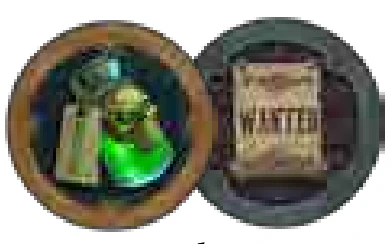
Markers are used as reminders and are usually given to other heroes as part of the card’s effect; Unlike tokens, markers are usually not placed on the board.

Two marker tokens: a green potion and a wanted poster
Markers

Minions

p. 18

Minions are non-hero units. There are three types of minions — Melee, Ranged and Heavy. See pages 6, 8 and 13.

Minion Battle

p. 18

Happens at the end of each round. The team with fewer minions removes the number of minions equal to the difference. See page 8.

Minion Defense Modifiers

p. 18

See page 14.

Minions Outside of the Battle Zone

p. 18

Displacing a minion miniature (by moving, pushing, or swapping it) has no impact on the Minion Battle.

If any minion miniature ends up outside the Battle Zone after you perform an action, move it by the shortest path of empty spaces to an empty space in the same Battle Zone. This is only relevant for minions represented by minion miniatures; objects that count as minions are unaffected!

If there are multiple valid shortest paths, the minion’s team decides. If there is no path to the Battle Zone, or the minion cannot move, place that minion in the nearest empty space of the Battle Zone.

In rare cases where the order matters, the team whose symbol is currently revealed on the Tie Breaker coin moves their minion first. Do not flip the Tie Breaker coin.

Move

p. 18

See “Movement in the Card Text” on page 11.

N

Nearest

p. 18

Whenever you need to figure out the distance between two spaces or objects, count the spaces between them (including spaces with obstacles).

Next Turn (Active Effect)

p. 18

The text that follows the “Next turn” keyword comes into effect at the start of the next turn and remains in effect for the duration of that entire turn. See “Active Effects”.

Next Turn, After Playing Cards (Active Effect)

p. 18

The text that follows the “Next turn, after playing cards:” keyword is applied once next turn, after all players have played and revealed their cards. See “Active Effects”.

O

Obstacle

p. 18

Units, terrain (including printed on the board), tokens, as well as any objects represented by miniatures, are obstacles. There can never be more than one obstacle in any one space. Ever. No exceptions.

P

Place

p. 18

Take a game piece (such as a miniature, or a token) from the board or from the supply, and put it into a different space. A game piece can only be placed into an empty space (this does not count as movement).

Tokens are intentionally limited. When a card tells you to place a token, take it from the supply first. If you need to place more tokens than are available in the supply, first remove up to that number of tokens of the same type from the board, if able.

Push (Unit / Token)

p. 18

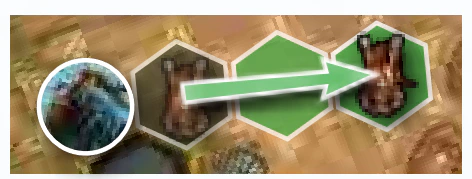
When a unit or a token is pushed, move it in a straight line directly away from the pushing unit the number of spaces equal to the push distance.

A hero pushing a minion two spaces along a straight line
“Push 2 spaces”

If the push is “ignoring obstacles”, or the obstacle can be “moved through”, the pushed target is moved through obstacles as long as it can reach an empty space.

If the target cannot be moved the full distance, move it as far as possible; this can result in pushing it 0 spaces.

If a card allows you to push multiple targets up to X spaces, you choose the distance and then push all those units that many spaces at the same time.

Also see “Minions Outside of the Battle Zone”.

R

Range / Ranged

p. 19

See Page 9.

Remove

p. 19

Remove a game piece (such as a miniature, or a token) from the board. Do not collect any coins.

Repeat

p. 19

See “Repeat” on page 10.

Replace

p. 19

Swap an object (such as a miniature or a token on the board) with a different object.

Resolved

p. 19

See “Changing Card States” on page 10.

Respawn

p. 19

If a card text instructs you to respawn a minion, place the minion miniature on the board into an empty space.

You can only respawn a minion if there are more minion spawn points of that type and color (empty or not), than there are minion miniatures of that type and color present in that Battle Zone. (To put it simply, a minion must first be removed, before it can be respawned).

Respawning heroes is covered on page 7.

Retrieve

p. 19

See “Changing Card States” on page 10.

S

Space

p. 19

A space is a single hex on the game board. Any space can be either empty, or contain a maximum of one obstacle.

Spawn

p. 19

Similar to place, but unlike “Place”, the spawned object must be taken from the supply and cannot be taken from the board.

Spawn Point

p. 19

Spaces on the board used to spawn minions and heroes. Spawn points are not obstacles. See pages 6-8.

Straight Line

p. 19

A straight line is a sequence of spaces arranged in a file. A single space counts as a straight line.

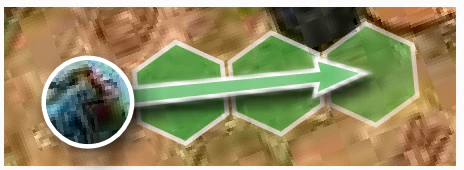
A hero with an arrow across three spaces in a straight line
“3 spaces in a straight line”

Two units are in a straight line if they are adjacent, or if you can draw a straight line of spaces through spaces occupied by both of those units.

Swap (with a Unit/Token)

p. 19

Two objects on the board swap places with each other. This does not count as movement or placement.

Swap (Cards)

p. 19

See “Changing Card States” on page 10.

T

Target (Unit / Token / Space)

p. 19

Whenever your action has any effect on another unit in any way, you target that unit.

Effects that check for unit presence (i.e. “if you are adjacent to a minion”) do not target.

Also see “Picking Targets” on page 10.

Terrain

p. 19

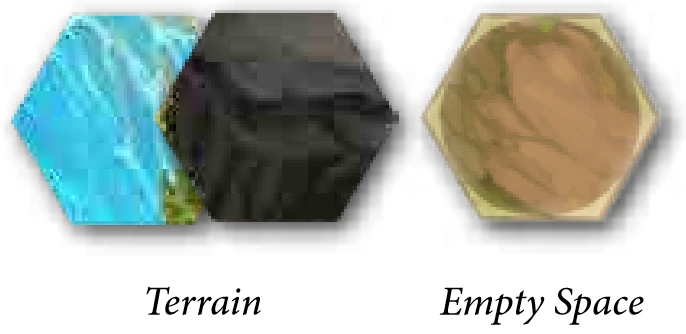
Any board space without a full grid outline counts as terrain and is an obstacle, including the water spaces surrounding the board.

Water and rock spaces labelled Terrain beside a sandy space labelled Empty Space

This Turn / Round (Active Effect)

p. 19

The text that follows the “This Turn” / “This Round” keyword comes into effect immediately and remains in effect for the duration of that entire turn / round.

Tokens

p. 19

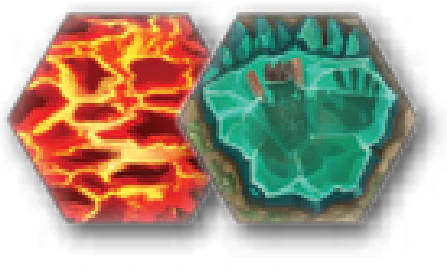
Tokens represent various temporary objects in the game. All tokens are obstacles.

A lava token and a green water token
Tokens

Once a token is placed, it retains all its properties until that token is removed (this does not include Active effects).

If a unit Spawns in a Spawn Point covered by a token, remove the token first, then spawn the unit.

All heroes have an option to remove any tokens they are adjacent to by performing a “Clear” action. See page 13.

Unless the card text says otherwise, tokens are removed at the end of round (See Page 8). Tokens are not removed when the hero who placed them is defeated.

U

Unit

p. 19

Units means heroes and minions. Tokens are not units.

Unresolved

p. 19

See “Changing Card States” on page 10.

Z

Zone

p. 19

A Zone is an area of the board comprised of multiple spaces.