Extended Player Counts
Extended Player Counts
p. 20This page covers several ways you can experience Guards of Atlantis II outside of the recommended 4 or 6 player count described on pages 5-6. Please note that none of these options are beginner friendly.
2 Players
p. 20Team play is one of the key aspects of Guards of Atlantis II and the game is balanced around having at least 4 heroes on the board.
This is why the best way to play the game with 2 players is with both players controlling two heroes each.
Note that playing the game this way is considerably more challenging, and will take longer to finish.
Use the same setup as for a 4 player game.
8 or 10 Players
p. 20When playing with 8 or more players, use the double-lane map (see below).
Odd Number of Players
p. 20While this is not the optimal player count, you can play Guards of Atlantis II with an odd number of players. To do this, you can use the Handicap cards.
Handicap Cards
p. 20Each hero has a Handicap card marked with an “H” instead of its tier value.
These cards are weaker versions of the regular basic cards (Usually Gold).
Their main purpose is to keep the game balanced when playing with an odd number of players.
- In games with 5, 7 or 9 players each player controls one hero, and all heroes on the team with more players replace one of their basic cards with a handicap card.
- When playing with 3 players, two players play normally, controlling one hero each, while the third (and the most experienced) player controls two heroes at the same time, and replaces a gold card of one of those heroes with a handicap card.
When playing with 3 or 5 players use the same number of life counters as in a 4 player game.
You can use the Handicap cards to calibrate the skill gap in games with an even player count by having the most experienced players use the Handicap card.
If you ever need to give any one player an even bigger advantage, you may let that player play with both their regular Gold card and its handicapped version in hand, increasing their hand size to six cards.
Playing on a Double-Lane Map
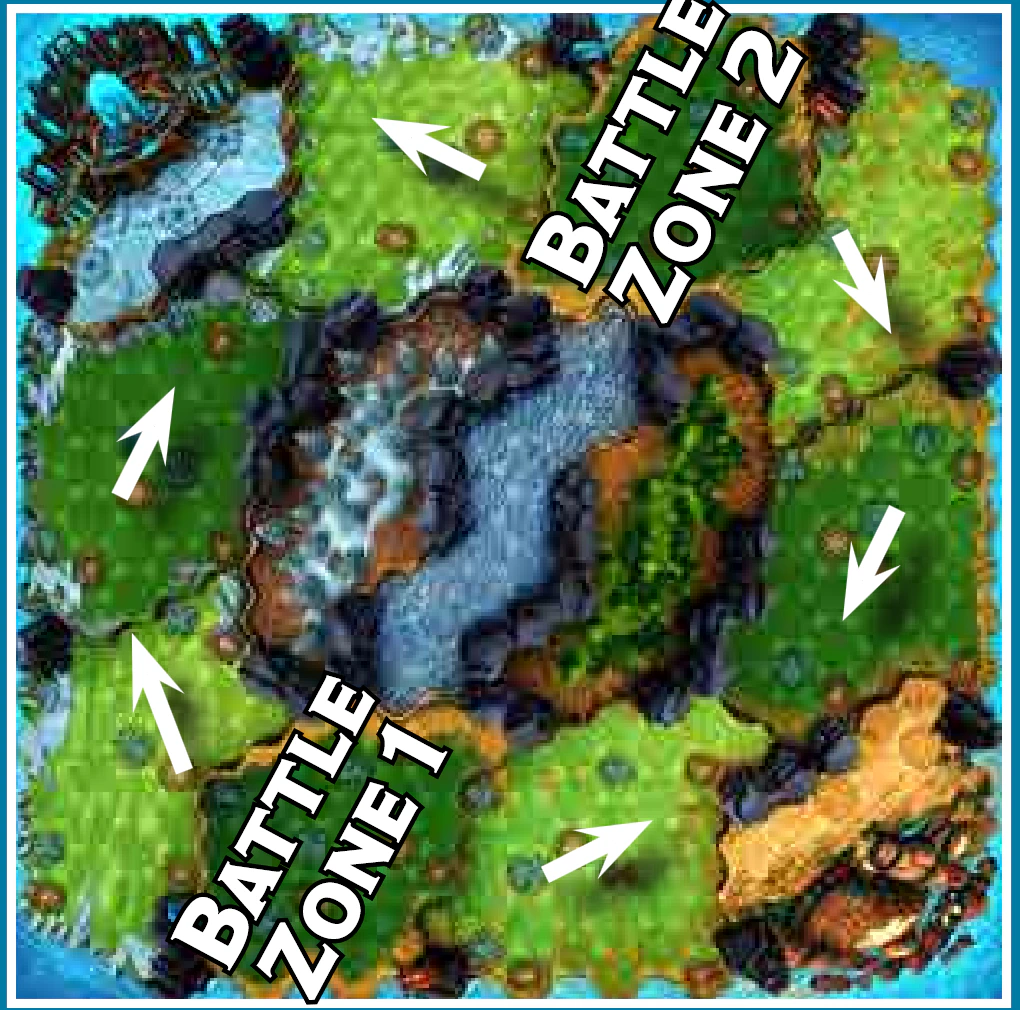
p. 20The double-lane map has two individual Lanes each with its own Battle Zone and minions.
Note: The double-lane map is considerably more challenging to play than a single-lane map. Make sure that every participant is very familiar with Guards of Atlantis II before using this map.
During setup, place the minions in the two starting Battle Zones (Battle Zone 1 and Battle Zone 2, as shown in the image below).
When playing with more than 3 heroes per team, place the remaining heroes into any empty spaces adjacent to their team’s occupied hero spawn points.
Pushes are tracked by two separate sets of Wave counters, one for each Lane. The number of Life counters used depends on the player count (See below).
| Player Count | Wave Counters | Life Counters |
|---|---|---|
| 6-8 Players | 2 x 7 | 6 |
| 9-10 Players | 2 x 7 | 7 |
When using the double-lane map, whenever an Action card refers to “the Battle Zone” treat it as “a Battle Zone”.
Minions are bound to the Battle Zone they were originally spawned in for the purpose of respawning and when applying the “Minions Outside of the Battle Zone” rules (See page 18).
Minion Battles in each of the two Battle Zones are resolved separately, but happen simultaneously.
- After the last Wave counter on either Lane is flipped, each team counts how many Zones on each Lane are between their Throne and that lane’s Battle Zone. The team with more total Zones between their Throne and both Battle Zones wins the game.
If both teams would win at the same time as the result of the push, spawn all minions in the Zones they occupied before the push and continue playing until only one team wins the game.